Summary and key findings

Tourism Research Australia (TRA) annually publish an analysis of tourism-related businesses in Australia, drawing on data from the Australian Bureau of Statistics (ABS). 

Tourism-related businesses fall into 2 main groups:

  • tourism characteristic industries, such as accommodation, where visitors consume at least 25% of output and therefore businesses in these industries are considered to be reliant on tourism
  • tourism connected industries, like automotive fuel retailing, where products are consumed by visitors in volumes considered to be significant, but still comprise less than 25% of consumed output.

The number of tourism-related businesses in Australia was 361,270 in June 2025. This is an increase of 237 or 0.1% on the number operating nationwide in June 2024 and an increase of 27,000 or 8.0% compared to June 2020.

Of the 361,270 tourism-related businesses as of June 2025:

  • 205,101 businesses (57% of total) were in tourism characteristic industries
  • 156,169 businesses (43%) were in tourism connected industries.

Tourism-related businesses comprised a significant 13.2% of all Australian businesses in June 2025, accounting for nearly 1 in 8 businesses in Australia.

The tourism-related industry with the highest growth rate (in terms of business numbers) over the past five years (between 2020 and 2025) was motor-vehicle hiring (up 65%). The industry with the largest contraction was Taxi transport (-24%).

Approximately 95% of tourism-related businesses in Australia are small businesses, with fewer than 20 employees. Nearly half (48%) of all tourism-related businesses have a turnover under $200,000.

Seventy per cent (254,000) of tourism-related businesses are in Australia’s capital cities or the Gold Coast.

The survival rate after 4 years of tourism-related businesses was 56%: of the 345,000 tourism related businesses in June 2021, 194,000 (56%) were still in business in June 2025.  This is lower than the survival rate for all Australian businesses over this period (63%).

Of the tourism-related industries, Clubs, pubs, taverns and bars had the highest 4-year business survival rate between 2021 and 2025 (70%). The tourism-related industry with the lowest 4-year business survival rate over this period was Taxi transport (44%). 

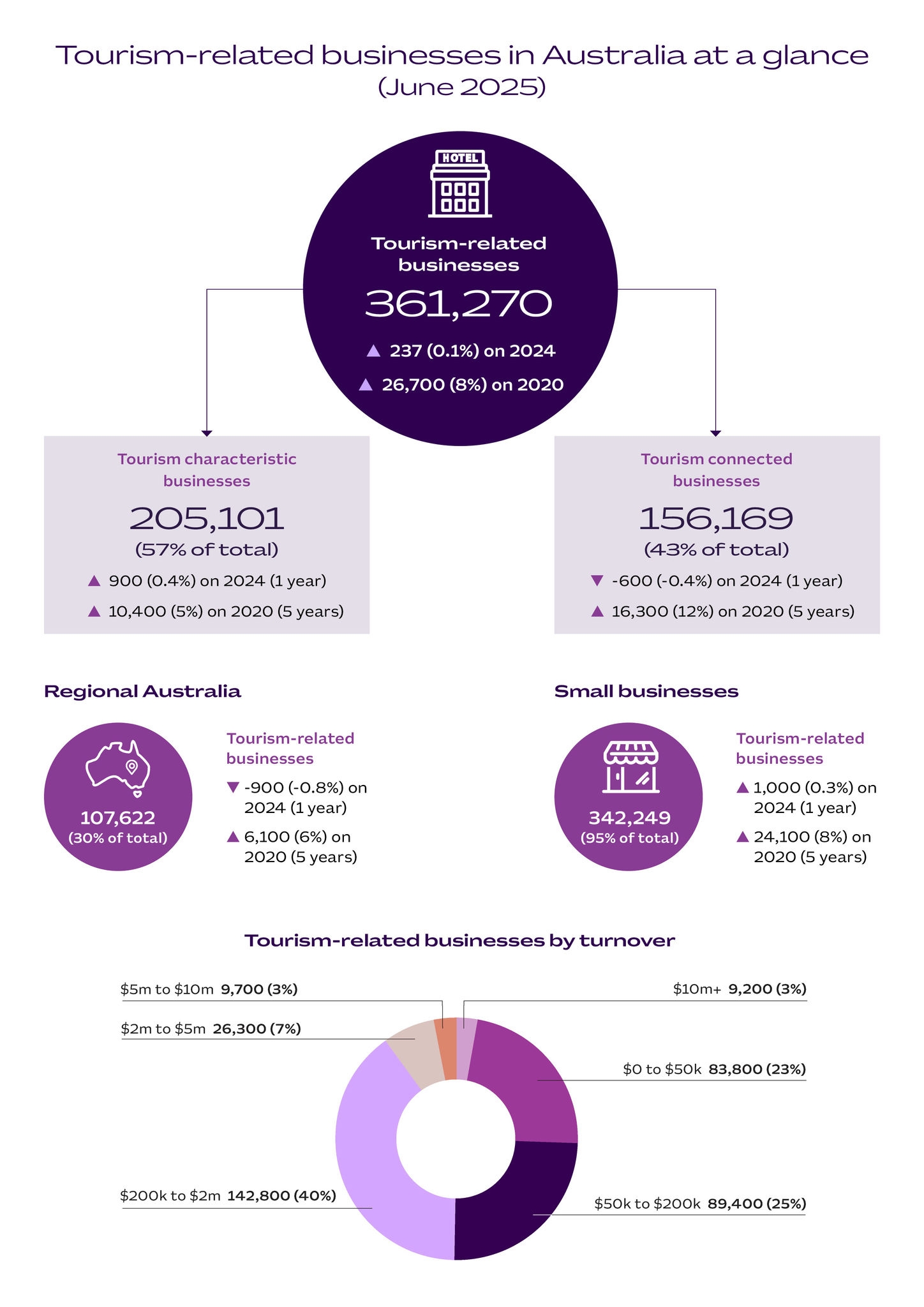
Tourism businesses in Australia at a glance (June 2025)

Chart showing tourism related businesses in Australia at a glance in 2025. The division is between tourism-characteristic, tourism-connected industries, proportion of businesses in regional Australia, number of small businesses, and tourism businesses by turnover.

1. Regional Australia includes all areas outside of state and territory capital cities and the Gold Coast tourism region.
2. Businesses with fewer than 20 employees  (including non-employing businesses).
3. Comparison is with 2020 rather than 2019 as this data series started at 2020.

The infographic above shows tourism business statistics including total number of businesses. The division is between tourism-characteristic, tourism-connected industries, proportion of businesses in regional Australia, number of small businesses, and tourism businesses by turnover. Statistics as follows:

  • There were a total of 361,270 tourism-related businesses in Australia in June 2025. This is an increase of 237 business (0.1%) on last year (June 2024) and an 8% increase (36,700 business) on June 2020.
  • 57% of tourism-related businesses are from tourism-characteristic industries, while the other 43% are from tourism-connected industries.
  • The number of tourism-characteristic businesses has increased by 0.4% since June 2024 and by 5% since 2020.
  • The number of tourism-connected businesses has decreased by 0.4% since June 2024 but increased by 12% since 2020.
  • Regional Australia stats: 30% of tourism-related businesses are located in regional Australia. This has remained relatively consistent since 2020.
  • Small businesses stats: 95% of tourism-related businesses are classified as small (with less than 20 employees including non-employing businesses). 

The most common turnover range of tourism-related businesses in 2024-25 (encompassing 40% of businesses) was $200,000 to $2 million. Next were $50,000 to $200,000 (with 25%) and $0 to $50,000 (with 23%). Businesses with turnover greater than $2 million accounted for only 13% (7% for $2 million to $5 million; 3% for $5 million to $10 million and 3% for over $10 million).

Growth in tourism-related business numbers (2020 to 2025)

Figure 1: Number of tourism-related businesses (June 2020 to June 2025)

chart created with amCharts | amCharts

Column graph showing the number of tourism-related businesses in Australia each year between 2020 and 2025. The total number of businesses by year is as follows:

  • 2020: 335,000
  • 2021: 345,000
  • 2022: 361,000
  • 2023: 358,000
  • 2024: 361,000
  • 2025: 361,000

Tourism-related businesses grew by 8% between 2020 and 2025, with most of this growth occurring between 2020 and 2022. Business numbers have remained quite stable at around 361,000 from 2022 to 2025. 

Tourism characteristic vs tourism connected businesses

Tourism characteristic industries experienced far lower growth in the number of businesses between 2020 and 2025 than tourism connected industries (5% vs 12%).

Comparison with all industries

For context, the total number of Australian businesses grew by 18% over the same period (2020 to 2025), showing that tourism-related businesses are growing at a slower rate than the overall Australian business landscape, over a five-year period. (Source: Australian Bureau of Statistics, Counts of Australian Businesses, including Entries and Exits). 

Industries

Accounting for 2 in 3 tourism-related businesses, 2 industries – retail trade and cafes, restaurants and takeaway food services – play a significant role in the tourism industry and are important drivers of economic activity. In June 2025:

  • retail trade (a tourism-connected industry) was the largest tourism-related industry, with 152,000 businesses (42% of total).  
  • cafes, restaurants and takeaway food services (a tourism-characteristic industry) was the largest tourism-characteristic industry, with 89,000 businesses (25% of total tourism-related businesses). 

Figure 2: Number of tourism-related businesses by industry (June 2025)

chart showing tourism characteristic industries at the top, and tourism connected industries at the bottom

Bar graph showing the number of tourism-related businesses in Australia in June 2025 by industry. It also shows each industry’s share of all tourism-related businesses. The industries are categorised as tourism-characteristic industries or tourism-connected industries.

The graph shows that the largest industry is other retail trade - accounting for 42% of tourism-related businesses. The next three largest industries are cafes, restaurants and takeaway food services (25%), taxi transport (9%) and cultural services (6%). 

Changes in tourism businesses by industry (2020 to 2025)

Over this 5-year period:

  • the largest relative increase in business numbers was seen in motor-vehicle hiring (up 64% or 1,500 businesses)
  • the largest relative decline was in taxi transport (down 24% or 10,300 businesses).  

The largest growth in absolute terms was in:

  • other retail trade (up 16,000 businesses or 12%)
  • cafes, restaurants and takeaway food services (up 11,600 businesses or 15%).

Figure 3: Change in the number of tourism-related businesses (June 2020 to June 2025)

Bar graph showing the change in change in the number of tourism-related businesses by industry between 2020 and 2025.

The data shows that the number of tourism-related businesses as a whole increased by 8% over this period.

The industry with the largest percentage increase was motor vehicle hiring (which increased by 64% (1,500 businesses), then cultural services (29% or 4,700) and other sports and recreation services (19% or 2,700). 4 industries have declined since 2019. These were taxi transport (which suffered a 24% reduction (10,300 businesses), Casinos and other gambling services (with a 9% reduction), passenger transport (with a 3% reduction) and accommodation with a 2% reduction (300 businesses).

Tourism-related businesses by size

In June 2025, around 4 in 5 (78%) tourism-related businesses were non-employing (i.e. sole operator) or micro businesses (with 1–4 employees). While only 5% of tourism-related businesses were medium or large businesses (20 or more employees), this is a higher proportion than that of all Australian industries (3%).

This breakdown of businesses by size has remained relatively stable since 2019-20.

Figure 4: Number of tourism-related businesses by size (June 2025)

Column graph showing the number of tourism-related businesses in Australia in June 2025 by size (based on employee numbers). The data shows that 50% of tourism-related businesses are non-employing, 27% are micro (1-4 employees), 17% are small (5-19 employees), 5% are medium (20-199 employees) and just 0.3% are large (with 200 or more employees). 

Tourism-related businesses by turnover

Almost half (48%) of tourism-related businesses had a turnover under $200,000, while 5% of tourism-related businesses had a turnover of more than $5 million. By contrast, 56% of all Australian businesses had a turnover under $200,000, while 4% had a turnover over $5 million.

The most common turnover range for tourism-related businesses was between $200,000 to $2 million, for 40%, or 2 in 5, tourism-related businesses. 

Figure 5: Number of tourism-related businesses by turnover (June 2025)

Column graph showing the number of tourism-related businesses in Australia in June 2025 by annual turnover. The data shows that 23% of businesses had a turnover under $50,000; 25% had a turnover between $50,000 and $200,000 and 40% had a turnover between $200,000 and $2,000,000. 7% of businesses had a turnover between $2 million and $5 million, 3% between $5 million and $10 million and just 3% had a turnover greater than $10 million. 

Location of tourism-related businesses

Seven in 10 (70% or 254,000) of tourism-related businesses are in Australia’s capital cities or the Gold Coast. Three in 10 (30% or 107,000) are in regional Australia. The proportion of tourism-related businesses in regional areas remained relatively stable at around 30% between 2020 and 2025. However, the rate of growth of capital-city based tourism-related businesses was higher than that of regional businesses over the 5 years between 2020 and 2025 (9% and 6% respectively).

The 3 most populous states are home to 82% of all tourism-related businesses in Australia:

  • New South Wales – 119,000 tourism-related businesses (33% of the national total)
  •  Victoria – 110,000 (30% of total)
  • Queensland – 66,000 (18% of total). 

Figure 6: Number of tourism-related businesses by state and territory (June 2025)

Note: State total and % of Australian total shown at top of columns.

Column graph showing the number of tourism-related businesses by state (grouped by capital city, regional areas and total). The number of businesses by state is:

  • New South Wales:  119 thousand (33%)
  • Vic: 110 thousand (30%)
  • Qld: 66 thousand (18%)
  • WA: 32 thousand (9%)
  • SA: 19 thousand (5%)
  • Tas: 6 thousand (2%)
  • ACT: 5 thousand (1%)
  • NT: 3 thousand (1%)

Figure 7: Top 10 tourism regions by number of tourism-related businesses (June 2025)

Bar graph showing the top ten tourism regions in terms of the number of tourism-related businesses. The graph shows that the largest tourism-region in terms of business numbers was Sydney (with 81,000). Next were Melbourne (80,000), Brisbane (31,000) and Destination Perth (26,000). 

Survival rate of tourism related businesses (2021-2025)

Of the 344,000 tourism-related businesses operating in June 2021, 193,000 (56%) were still operating 4 years later in June 2025. This rate is slightly lower than that reported for the 2020 to 2024 period (58%).

This 4-year business survival rate for tourism-related businesses was significantly lower than that of all Australian businesses over the same period (63%). 

A slight decline in the 4-year business survival rate was also seen in all Australian businesses. The 4-year business survival rate for all Australian businesses decreased from 64% (for the 2020-2024 period) to 63% (for the 2021-2025 period). (Source: Australian Bureau of Statistics, Counts of Australian Businesses, including Entries and Exits).

Survival rate of tourism-related businesses by business size

The survival rate of tourism-related businesses over this period was directly proportional to business size, with larger businesses having a much greater survival rate than smaller businesses. For example, some 4-year survival rates by business size were:

  • 88% of large businesses (200+ employees)
  • 60% of micro businesses (those with between 1 and 4 employees) and
  • 47% of non-employing businesses.

Figure 8: 4-year survival rate of tourism-related businesses (June 2021 to June 2025)

Column graph showing the 4-year business survival rate between 2021 and 2025 of tourism-related business grouped by business size. These survival rates are:

Business size: Survival rate (2021 to 2025)

  • Non-employing 47%
  • Micro (1-4): 60%
  • Small (5-19): 68%
  • Medium (20-199): 81%
  • Large (200+): 88%
  • Total: 56%

Survival rate of tourism related businesses by industry

The industries with the highest survival rates over this 4-year period were:

  • clubs, pubs, taverns and bars (74%)
  • passenger transport (65%)
  • accommodation (64%).

The industries with the lowest survival rates were:

  • casinos and gambling services (57%)
  • cafes, restaurants and takeaway food services (51%)
  • taxi transport (44%).  

Figure 9: Business survival rate by industry (2021 to 2025)

Column graph showing the 4-year business survival rate between 2021 and 2025 of tourism-related business by industry. The graph shows that the industry with the highest survival rate was Clubs, pubs, taverns and bars (70% survival rate). Next were Accommodation (64%) and Passenger transport (64%).

The 3 industries with the lowest survival rates were Travel agency and tour operator services (58%), Cafes, restaurants and takeaway food services (51%) and taxi transport (44%). 

Factors affecting tourism business numbers

Significant decline in taxi transport industry businesses

The total number of tourism-related businesses and shifts over time are influenced significantly by changes in the taxi transport industry.

Accounting for 13% of all tourism-related businesses in 2020, the number of businesses in this industry decreased by 10,300 (24%) between 2020 and 2025, materially influencing the total number of tourism-related business.  

External sources attribute this decline to competition from the rideshare industry rather than a reduction in demand for taxi/rideshare services (Roy Morgan 2025).

If the taxi-transport industry is separated from the analysis of total tourism-related businesses, the number of businesses from the remaining tourism-related industries increased by 13% between June 2020 and June 2025 – rather than the 8% increase reported with the taxi-transport industry included in the figures.

Figure 10: Number of businesses by industry – taxi transport industry vs other tourism-related industries (June 2020 vs June 2025)

Stacked column chart showing the change in the number of taxi transport businesses compared with that of all other tourism-related industries. While the number of taxi-transport businesses decreased by 24% between 2020 and 2025, the number from all other tourism-related industries increased by 13%. 

Note: figures in brackets show % change between 2020 and 2025.

Domestic tourism competing with outbound international travel

The strong growth in tourism-related business numbers between 2020 and 2022 was likely enhanced by strong domestic tourism demand due to the closure of Australia’s international borders during that period. Once Australia’s international borders were reopened, outbound international travel recovered quickly, with the growth of international outbound travel aligning with a stabilisation of domestic overnight trips (see fig. 11). This stabilisation of domestic overnight trips has coincided with the stabilisation of tourism-related business numbers between 2022 and 2025.

This trend is most apparent for Tasmanian tourism-related businesses (which rely more on interstate travel than other states (note: 71% of domestic overnight spend in Tasmania was from interstate visitors in 2024-25 compared with just 44% for other states; source: TRA)). The number of tourism-related businesses in Tasmania decreased by 3.2% between 2022 and 2025 while the national figure grew by 0.2% over the same period.

Figure 11: Domestic overnight trips vs outbound international trips by Australians (rolling annual total)

Line chart showing the number of domestic overnight trips and number of outbound international trips by Australians between December 2019 and June 2025. While the number of outbound international trips decreased to almost zero between 2020 and 2021, the number of domestic overnight trips recovered rapidly and had fully recovered to pre-covid levels by mid-2022. However, while the number of outbound international trips gradually increased between 2022 and 2025, the number of domestic overnight trips did not increase over this period.  

Note: Figures show yearly totals to the date indicated

Methodology and definitions

The data and summary information is derived from the ABS Business Register database, based on selected businesses from tourism-related industries as defined in the ABS Tourism Satellite Account. The Australian Bureau of Statistics Business Register (ABSBR) is populated using administrative data from Australian Business Number (ABN) registrations recorded in the Australian Business Register (ABR), and business data from the Australian Taxation Office (ATO).  

See: ABS Tourism Satellite Account Methodology for more information.

Contact us

mail   tourism.research@tra.gov.au